Orrery
SRE agents you can let near production.
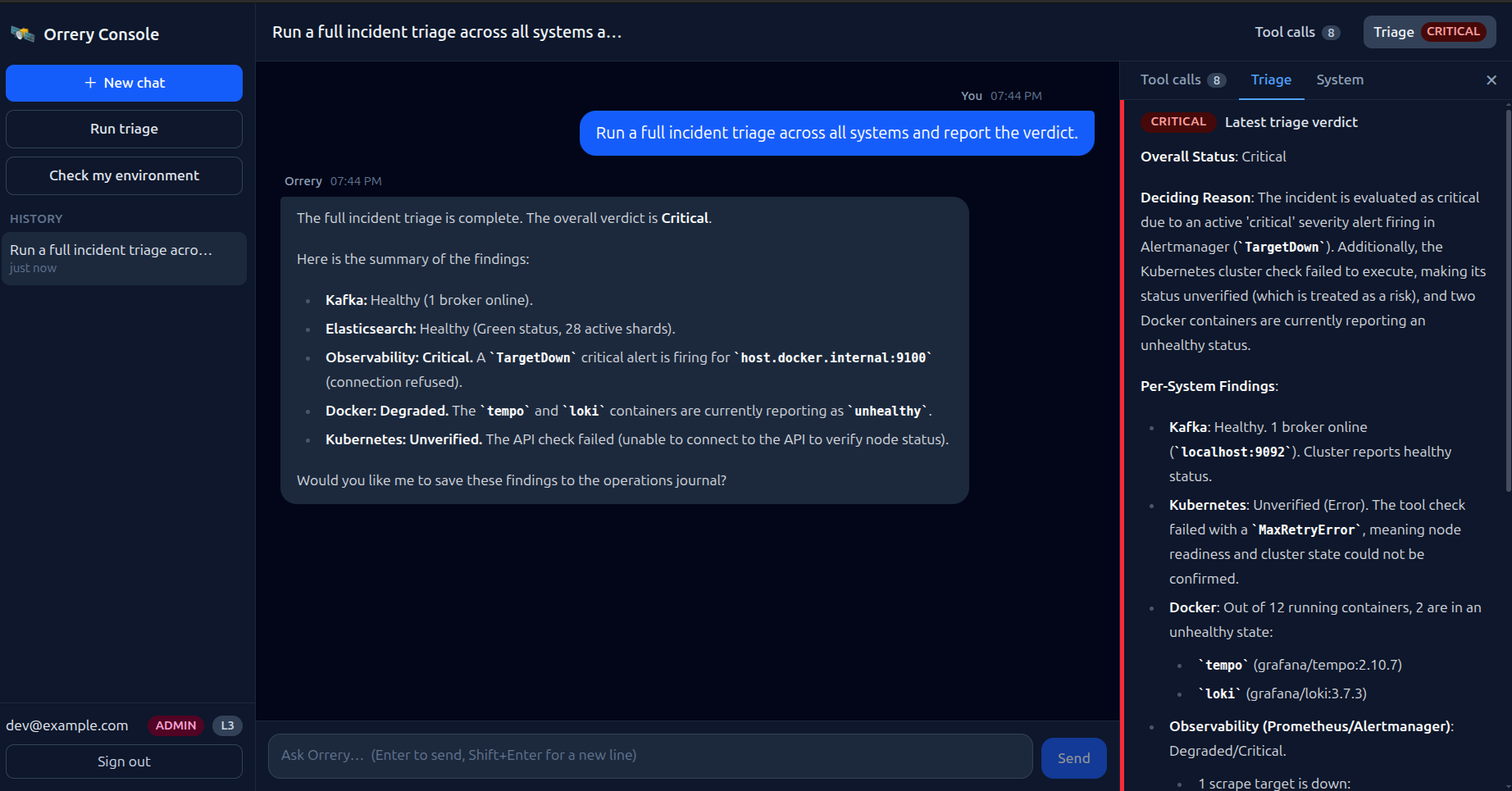
Autonomous DevOps & SRE agents that investigate, correlate and remediate — with a human gate on every destructive action. Specialists for Kafka, Kubernetes, Elasticsearch, Docker and Prometheus/Loki orbit a root coordinator that runs them in parallel and correlates what they find. Built on Google ADK, open source under MIT.
Pick your path
-
I want to try it
Run the full stack locally in Docker in under 5 minutes — Kafka, Postgres, Prometheus, and the orchestrator ready to go.
-
I want to deploy it
Helm chart, multi-replica Postgres sessions, HPA, rolling updates, and observability scrape targets.
-
I want to extend it
Add your own specialist agent, wire it into the orchestrator, and ship it behind the same RBAC + guardrails.
-
I want a chat surface
Bring the agents into Slack or Google Chat with interactive Approve / Deny cards and email/user-ID RBAC.
Architecture Overview
The platform follows a Coordinator-Specialist pattern. A root orchestrator analyzes user intent and delegates to specialized agents. Cross-cutting concerns like safety, observability, and resilience are handled globally via a plugin system.
graph LR
    subgraph Frontends
        direction TB
        WEB[Web UI / CLI]
        SLACK[Slack]
        GCHAT[Google Chat]
    end

    subgraph Orchestrator
        ROOT[Orrery Chat]
    end

    subgraph Specialists
        direction TB
        KAFKA[Kafka Agent]
        K8S[K8s Agent]
        OBS[Observability]
        ES[Elasticsearch]
        DOCKER[Docker Agent]
        JOURNAL[Ops Journal]
        TRIAGE[Incident Triage]
    end

    subgraph Plugins
        direction TB
        P1[RBAC & Guardrails]
        P2[Metrics & Audit]
        P3[Memory & Resilience]
    end

    WEB --> ROOT
    SLACK --> ROOT
    GCHAT --> ROOT

    ROOT --> KAFKA
    ROOT --> K8S
    ROOT --> OBS
    ROOT --> ES
    ROOT --> DOCKER
    ROOT --> JOURNAL
    ROOT --> TRIAGE

    ROOT -.-> P1
    ROOT -.-> P2
    ROOT -.-> P3
Jump to a topic
-
What's in the box — every agent, its tools, and the role each tool requires.
-
Three risk tiers, three roles, and how the confirmation gate works end-to-end.
-
JWT-authenticated HTTP front door, claim-to-role mapping, and the
SecretsManagerfor mounted Kubernetes Secrets. -
Let agents recall past incidents, resolutions, and team preferences.
-
Index your runbooks, postmortems and ADRs so the agent answers from what your team wrote — with a citation and a document age.
-
Prometheus metrics, OpenTelemetry traces, and log↔trace correlation — with a one-command Grafana stack.
-
Operating Orrery itself: the first five minutes, escalation, and a page per alert.
-
Common errors across every surface with pointers to the fix.
Core Philosophy
- Safety First: No destructive tool executes without verified human confirmation.
- Autonomous Investigation: Agents run diagnostics in parallel, mimicking an SRE's thought process.
- Closed-Loop Remediation: Actions are always followed by verification and retry loops.
- Observable by Design: Every interaction is instrumented with Prometheus metrics, OpenTelemetry traces, and audit logs.
Project Structure
| Component | Path | Description |
|---|---|---|
| core | core/ | Shared library: agent factories, plugin system, validation, and base configurations. |
| agents | agents/ | Specialist agent implementations (Kafka, K8s, Docker, etc.). |
| infra | infra/ | Local diagnostic stack (Prometheus, Loki, Kafka, Grafana). |
| roadmap | docs/enhancements/ | Ongoing development and enhancement proposals (AEP). |
Background: how this was built
The reference pages above describe what Orrery does. Building AI Agents for DevOps is a twelve-part series on why it does it that way — the decisions, the dead ends, and the rewrites behind each subsystem. Every part maps onto a page in these docs.
Two standalone pieces go wider than the series: The agent gateway on how five surfaces share one gate, and How to build AI agents on the patterns that generalise beyond this codebase.