orrery-core
Shared library providing the foundation for all agents: agent factory, plugins, RBAC, guardrails, input validation, audit logging, resilience, and typed configuration.
Tool Results
ToolResult
A Pydantic model for structured tool outputs. While agents can return raw dicts, using ToolResult ensures consistency and enables machine-readable error handling for cross-agent composition (e.g., remediation loops).
from orrery_core import ToolResult


async def my_tool(name: str) -> dict:
    if not name:
        return ToolResult.error("Name is required", error_type="MissingInput").to_dict()

    return ToolResult.ok(message=f"Hello {name}", length=len(name)).to_dict()
- Factories:
ok(),error(),partial(). - Fields:
status,message,error_type,data,remediation_hints. - Flattening:
.to_dict()flattensdatainto the top level for backward compatibility with legacy consumers while keeping reserved fields (status,message, etc.) safe.
Operator Registry
OperatorRegistry
A central registry for Kubernetes operator awareness. It allows agents to reason about high-level custom resources (like Strimzi Kafka or ECK Elasticsearch) instead of just low-level Pods.
from orrery_core import default_registry

# Look up a detector by CRD group
detector = default_registry.get_by_group("kafka.strimzi.io")

# Interpret raw CR status into a unified OperatorStatus
status = detector.interpret_status("Kafka", raw_cr_dict)
print(status.healthy, status.phase, status.warnings)
Ships with built-in support for Strimzi and ECK. New operators can be registered by implementing the OperatorDetector protocol.
Plugins
Cross-cutting concerns are packaged as ADK BasePlugin subclasses and registered once on the Runner via default_plugins(). Plugins apply globally to every agent, tool, and LLM call — no per-agent callback wiring needed.
default_plugins()
Creates the standard set of plugins in the correct registration order:
from orrery_core import default_plugins
from google.adk.runners import Runner

runner = Runner(
    agent=root_agent,
    app_name="myapp",
    session_service=session_service,
    plugins=default_plugins(),
)
| Order | Plugin | Description |
|---|---|---|
| — | TracingPlugin | OpenTelemetry span enrichment. Prepended only when tracing is enabled (enable_tracing / OTEL_TRACING_ENABLED) |
| — | AuthPlugin | Applies the verified JWT role each turn. Added only when enable_auth=True |
| 1 | GuardrailsPlugin | RBAC (authorize()) + confirmation gate (require_confirmation() or dry_run()) + ensure_default_role() |
| 2 | ResiliencePlugin | Per-tool circuit breaker |
| 3 | MetricsPlugin | Prometheus metrics (tool counts, latency, errors, circuit breaker state) |
| 4 | AuditPlugin | Structured audit logging for every tool invocation |
| 5 | ActivityPlugin | Records tool calls to session state for cross-agent visibility (when enable_activity_tracking) |
| 6 | MemoryPlugin | Auto-saves sessions to long-term memory after the root agent completes (when enable_memory) |
| 7 | ErrorHandlerPlugin | Graceful error recovery for tool and model failures (must be last) |
Each plugin's ADK adapter lives in orrery_core/plugins/<name>_plugin.py; the mechanism it wraps lives under the matching aspect package (e.g. ResiliencePlugin → reliability/resilience.py's CircuitBreaker).
Parameters:
| Parameter | Default | Description |
|---|---|---|
role_policy | None | Custom RolePolicy for RBAC overrides |
guardrail_mode | "confirm" | "confirm", "dry_run", or "none" |
circuit_breaker_threshold | 5 | Failures before circuit opens |
circuit_breaker_timeout | 60.0 | Recovery timeout in seconds |
audit_log_path | None | Optional local audit log file path |
enable_activity_tracking | True | Whether to track activity in session state |
enable_memory | False | Auto-save sessions to long-term memory (requires a memory_service on the Runner) |
memory_min_events | 4 | Minimum events before a session is saved to memory |
enable_auth | False | Add AuthPlugin to apply the verified JWT role each turn |
require_auth | True | With enable_auth, force viewer when no verified _auth payload is present |
enable_tracing | None | Prepend TracingPlugin. None resolves from OTEL_TRACING_ENABLED |
Individual plugins
Each plugin can also be instantiated independently for custom configurations:
from orrery_core import (
    GuardrailsPlugin,
    ResiliencePlugin,
    MetricsPlugin,
    AuditPlugin,
    ActivityPlugin,
    ErrorHandlerPlugin,
)

plugins = [
    GuardrailsPlugin(mode="dry_run"),  # dry-run mode for testing
    ResiliencePlugin(failure_threshold=3),  # custom threshold
    MetricsPlugin(),
    AuditPlugin(log_path="audit.jsonl"),  # also write to local file
    ErrorHandlerPlugin(),
]
Plugins vs callbacks
Plugins registered on the Runner apply globally and run before any agent-level callbacks. If a plugin returns a value, the agent-level callback is skipped. Use agent-level callbacks only for agent-specific logic (e.g., Slack's custom confirmation buttons).
Agent Factory
create_agent()
Creates an ADK Agent with sensible defaults. Since cross-cutting concerns are handled by plugins, agent definitions are simple:
from orrery_core import create_agent, load_agent_env

load_agent_env(__file__)

root_agent = create_agent(
    name="my_agent",
    description="What this agent does.",
    instruction="How the agent should behave.",
    tools=[my_tool, another_tool],
)
| Parameter | Description |
|---|---|
name | Agent name (used by ADK for routing) |
description | Used by parent orchestrators to decide when to delegate |
instruction | System prompt for the agent |
tools | List of async tool functions |
model | Override model — can be a string (Gemini) or BaseLlm instance (LiteLlm). When None, resolved from MODEL_PROVIDER/MODEL_NAME env vars via resolve_model() |
planner | Optional ADK planner attached to this agent. Use resolve_planner() to read the choice from env. Reserve for orchestration / reasoning agents — tool-leaf agents do not benefit |
sub_agents | List of child agents for orchestrators |
output_key | Session state key to store this agent's output (read by downstream graph nodes) |
mode | ADK 2.0 delegation mode — chat / task / single_turn. Leave None and ADK infers it (chat as a sub-agent, single_turn as a graph node); set chat explicitly on a Workflow/App root coordinator so it keeps conversation history |
Agent-level callback parameters (before_tool_callback, after_tool_callback, etc.) are still supported for agent-specific logic but are not needed for standard cross-cutting concerns.
resolve_planner()
Returns an ADK BasePlanner (or None) based on the ORRERY_PLANNER env var. Planning adds an explicit reasoning step before tool calls — useful for orchestration agents that route across specialists, less useful for narrow tool-leaf agents.
from orrery_core import create_agent, resolve_planner

_planner = resolve_planner()  # read once at import time

root_agent = create_agent(
    name="orchestrator",
    description="Routes across specialist agents.",
    instruction="…",
    tools=[…],
    planner=_planner,  # opt-in per agent
)
ORRERY_PLANNER | Behavior |
|---|---|
none (default) | No planner attached; identical to pre-planner behavior. |
plan_react | PlanReActPlanner — provider-agnostic; structures output into /*PLANNING*/, /*ACTION*/, /*REASONING*/, /*FINAL_ANSWER*/ phases. Works with Gemini, Claude, OpenAI, and Ollama via the existing LiteLLM integration. |
builtin | BuiltInPlanner — uses Gemini's native thinking tokens. Falls back to None with a warning when MODEL_PROVIDER != gemini, since LiteLLM-routed models do not consume the ADK thinking config. |
Builtin-only knobs (consulted only when ORRERY_PLANNER=builtin):
| Variable | Default | Description |
|---|---|---|
ORRERY_PLANNER_THINKING_BUDGET | unset | Integer token budget for Gemini thinking. |
ORRERY_PLANNER_INCLUDE_THOUGHTS | true | Whether to surface the model's thoughts in the response stream. |
Where it's wired in orrery-assistant: the root orchestrator, the triage_summarizer, and the remediation_actor. All three are reasoning-heavy. Tool-leaf agents (per-system health checkers, the verifier, etc.) intentionally skip the planner — they would only add latency without improving output quality.
Deterministic multi-step flows — ADK 2.0 graph Workflow
The create_sequential_agent() / create_parallel_agent() / create_loop_agent() factories were removed in the ADK 2.0 upgrade — those SequentialAgent / ParallelAgent / LoopAgent wrappers are deprecated. Compose structured, non-LLM-delegated flows as a graph Workflow instead: create_agent() LlmAgents are graph nodes (an LlmAgent is a BaseNode in ADK 2.0), and routing is pure-Python FunctionNodes. Edges are chain-tuples (sequential), node-tuples (parallel), and RoutingMap dicts (conditional/loop); a JoinNode is the parallel fan-in barrier.
from google.adk import Workflow
from google.adk.workflow import JoinNode

health_join = JoinNode(name="health_join")

triage = Workflow(
    name="incident_triage",
    description="Full incident triage pipeline.",
    edges=[
        # Fan out to parallel checkers, join, then summarize → journal
        ("START", (kafka_checker, k8s_checker, docker_checker)),
        ((kafka_checker, k8s_checker, docker_checker), health_join),
        (health_join, summarizer, journal_writer),
    ],
)
Nodes pass data via output_key, which writes to session state for downstream nodes to read. See ADR-003 for the full rationale and the closed-loop remediation pattern (actor → verifier → verify_route bounded by a state counter, replacing LoopAgent).
load_agent_env(__file__)
Loads the .env file located next to the calling module.
Async Tools
All tool functions must be async def. Use asyncio.to_thread() or asyncio.create_subprocess_exec() to offload blocking I/O:
import asyncio
from orrery_core import with_retry, destructive


@with_retry(max_retries=3, retryable=(ConnectionError, TimeoutError))
async def list_topics() -> dict:
    admin = _get_admin_client()
    metadata = await asyncio.to_thread(admin.list_topics, timeout=10)
    return {"status": "success", "topics": list(metadata.topics.keys())}


@destructive("permanently deletes the topic")
async def delete_topic(topic_name: str) -> dict: ...
The @with_retry decorator automatically detects async functions and uses await asyncio.sleep() for backoff delays.
Resilience
Fault-tolerance utilities for handling transient failures and service outages.
ResiliencePlugin / CircuitBreaker
Per-tool circuit breaker applied globally via the ResiliencePlugin. When a tool exceeds the failure threshold, subsequent calls are short-circuited until a recovery timeout allows a probe.
| State | Behavior |
|---|---|
| Closed | All calls pass through normally |
| Open | Calls are blocked with {"error_type": "CircuitOpen", ...} |
| Half-open | One probe call is allowed after recovery_timeout seconds |
@with_retry
Decorator for async tool functions that adds retry with exponential backoff and jitter.
from orrery_core import with_retry


@with_retry(max_retries=3, retryable=(ConnectionError, TimeoutError))
async def list_kafka_topics(timeout: int = 10) -> dict: ...
| Parameter | Default | Description |
|---|---|---|
max_retries | 3 | Max retry attempts (total calls = max_retries + 1) |
base_delay | 1.0 | Initial backoff delay in seconds |
max_delay | 30.0 | Cap on backoff delay |
retryable | (ConnectionError, TimeoutError, OSError) | Exception types that trigger a retry |
Apply @with_retry to read-only tools that call external services. Do not apply to mutating operations (create, delete) where retries could be dangerous.
Error Handling
ErrorHandlerPlugin
Handles both tool and model errors globally. When a tool raises an exception, it returns a structured error dict so the LLM can reason about it:
{"status": "error", "error_type": "KafkaException", "message": "Tool 'get_kafka_cluster_health' failed: broker down"}
When a model call fails, it returns a friendly LlmResponse message.
The underlying factories (graceful_tool_error(), graceful_model_error()) can still be used directly as agent-level callbacks if needed.
Input Validation
Reusable validators for tool inputs. Each returns None on success or {"status": "error", "message": ...} on failure. Use the walrus operator for concise early-return:
from orrery_core.validation import validate_string, validate_positive_int, KAFKA_TOPIC_PATTERN


async def create_kafka_topic(topic_name: str, num_partitions: int = 1) -> dict:
    if err := validate_string(topic_name, "topic_name", pattern=KAFKA_TOPIC_PATTERN):
        return err
    if err := validate_positive_int(num_partitions, "num_partitions", max_value=10_000):
        return err
    ...
Available Validators
| Validator | Key Parameters | Description |
|---|---|---|
validate_string() | min_len, max_len, pattern | Length bounds + optional regex |
validate_positive_int() | min_value, max_value | Integer range (rejects bool, float, str) |
validate_url() | allowed_schemes | Scheme allowlist; rejects javascript:, data:, file: |
validate_path() | — | Rejects .. path traversal |
validate_list() | min_len, max_len | List length bounds |
Constants
| Constant | Value | Usage |
|---|---|---|
MAX_LOG_LINES | 10,000 | Cap for log tail parameters |
MAX_REPLICAS | 1,000 | Cap for K8s replica scaling |
MAX_PARTITIONS | 10,000 | Cap for Kafka topic partitions |
MAX_REPLICATION_FACTOR | 10 | Cap for Kafka replication factor |
MAX_QUERY_LENGTH | 5,000 | Cap for Prometheus/Loki queries |
K8S_NAME_PATTERN | ^[a-z0-9]([a-z0-9._-]*[a-z0-9])?$ | Kubernetes resource name format |
KAFKA_TOPIC_PATTERN | ^[a-zA-Z0-9._-]+$ | Kafka topic name format |
Guardrails
Guardrails prevent destructive tools from executing without confirmation. They are enforced globally via the GuardrailsPlugin.
Marking tools as destructive
from orrery_core import destructive


@destructive("permanently deletes the topic and all its data")
async def delete_kafka_topic(topic_name: str) -> dict: ...
The @destructive() decorator marks the function with metadata. The GuardrailsPlugin reads this metadata at runtime and gates execution.
Confirmation flow
- User asks to delete a topic
- LLM calls
delete_kafka_topic GuardrailsPluginintercepts → returns{"status": "confirmation_required", ...}- LLM receives the message and asks the user to confirm
- User confirms → LLM calls the tool again → plugin allows it
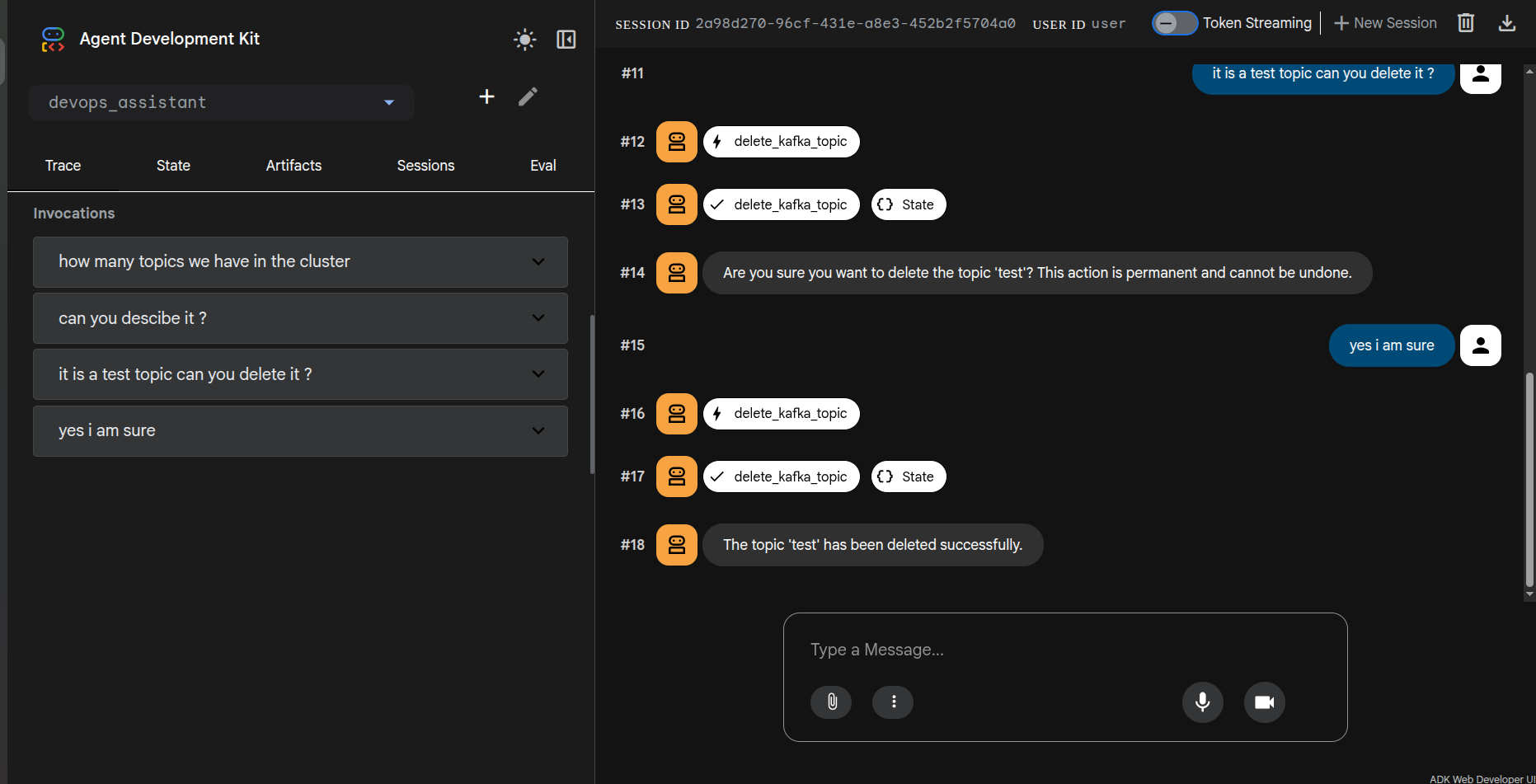
The guardrail intercepts delete_kafka_topic (#12-#13), asks the user to confirm (#14), and only executes after explicit confirmation (#15-#18).
Guardrail modes
| Mode | Behavior |
|---|---|
"confirm" (default) | Prompts for confirmation on @confirm/@destructive tools |
"dry_run" | Blocks all destructive tools permanently, showing what would have been done |
"none" | No confirmation gate (useful when the integration layer handles it, e.g., Slack buttons) |
Role-Based Access Control (RBAC)
Three-role hierarchy that reuses existing guardrail metadata to control who can call which tools. See ADR-001 for the full design rationale.
VIEWER (0)   → read-only tools (unguarded)
OPERATOR (1) → + mutating tools (@confirm)
ADMIN (2)    → + destructive tools (@destructive)
RBAC is enforced globally by the GuardrailsPlugin. It runs before the confirmation gate — unauthorized users are blocked before reaching the confirmation prompt.
RolePolicy
Maps tools to their minimum required role. By default, roles are inferred from @destructive/@confirm decorators. Use overrides for exceptions:
from orrery_core import RolePolicy, Role, default_plugins

policy = RolePolicy(overrides={"sensitive_read": Role.OPERATOR})
plugins = default_plugins(role_policy=policy)
@requires_role()
Decorator for explicit role annotation on tools that don't use @destructive/@confirm:
from orrery_core import requires_role, Role


@requires_role(Role.ADMIN)
async def manage_users() -> dict: ...
Setting the user role
Use set_user_role() to assign a role from trusted server-side code:
from orrery_core import set_user_role

initial_state = {}
set_user_role(initial_state, "admin")
session = session_service.create_session(state=initial_state, ...)
Invalid role values default to viewer. The GuardrailsPlugin calls ensure_default_role() via before_agent_callback to prevent privilege escalation from untrusted session state.
Testing roles across surfaces
For a hands-on guide to exercising viewer / operator / admin from ADK Web, adk run, Slack, Google Chat, and a custom Runner, see Testing RBAC across surfaces.
Structured Logging
setup_logging()
Configures the root Python logger with a JSON formatter that outputs structured log lines to stdout — container-friendly and ready for Loki, ELK, Splunk, or Cloud Logging.
Called automatically by load_agent_env(), so all agents get structured logging by default.
JSONFormatter
The underlying logging.Formatter that produces JSON output. Can be used standalone if you need custom handler configuration.
Audit Logging
AuditPlugin
Emits a structured audit entry for every tool invocation via the AuditPlugin. Each entry includes agent name, tool name, arguments, result, user ID, and session ID.
Sensitive arguments (containing password, secret, token, api_key, credential) are automatically redacted to ***.
An optional audit_log_path parameter in default_plugins() writes a local .jsonl file in addition to stdout.
Activity Tracking
ActivityPlugin
Records every tool call to session_log in session state via the ActivityPlugin. This makes all agent activity visible to get_session_summary() in the journal agent, regardless of which sub-agent performed the work.
Typed Configuration
AgentConfig
A pydantic-settings base class for typed, validated configuration. Replaces raw os.getenv() calls.
from orrery_core import AgentConfig, load_config


class KafkaConfig(AgentConfig):
    kafka_bootstrap_servers: str = "localhost:9092"


config = load_config(KafkaConfig, __file__)
print(config.kafka_bootstrap_servers)
print(config.model_provider)  # "gemini", "anthropic", "openai", etc.
print(config.model_name)  # "gemini-2.0-flash", "anthropic/claude-sonnet-4-20250514", etc.
Base fields (inherited by all configs):
| Field | Default | Env var | Description |
|---|---|---|---|
model_provider | "gemini" | MODEL_PROVIDER | LLM backend (gemini, anthropic, openai, ollama, ...) |
model_name | "gemini-2.0-flash" | MODEL_NAME | Model identifier |
google_genai_use_vertexai | True | GOOGLE_GENAI_USE_VERTEXAI | Use Vertex AI or AI Studio (Gemini only) |
google_cloud_project | None | GOOGLE_CLOUD_PROJECT | GCP project (Vertex AI only) |
google_cloud_location | None | GOOGLE_CLOUD_LOCATION | GCP region (Vertex AI only) |
google_api_key | None | GOOGLE_API_KEY | AI Studio API key (Gemini only) |
gemini_model_version | None | GEMINI_MODEL_VERSION | Legacy alias for MODEL_NAME when provider is gemini |
resolve_model()
Resolves the LLM model from environment variables. Called automatically by create_agent() when no explicit model is passed.
- For
MODEL_PROVIDER=gemini(default): returns a plain model string - For any other provider: returns a
LiteLlminstance via ADK's built-in LiteLLM integration
See Configuration reference for provider-specific env vars and API key setup.
load_config(ConfigClass, __file__)
Loads configuration from the .env file next to the calling module, with environment variable overrides.
Persistent Runner
run_persistent()
An async helper that runs an agent in a CLI loop with in-memory or PostgreSQL-backed sessions (set DATABASE_URL to persist). Supports plugins.
import asyncio
from orrery_core import run_persistent, default_plugins
from my_agent.agent import root_agent

asyncio.run(run_persistent(root_agent, app_name="my_agent", plugins=default_plugins()))
| Parameter | Default | Description |
|---|---|---|
agent | — | The root agent to run |
app_name | — | Application name for session scoping |
db_url | None (in-memory) | PostgreSQL URL; falls back to DATABASE_URL, then in-memory |
user_id | "default_user" | User ID for session scoping |
plugins | None | List of ADK plugins (use default_plugins() for standard set) |
Session state (notes, preferences, bookmarks) survives across restarts. Type new for a fresh session or quit to exit.
For the web UI, use ADK's built-in persistence flag instead: